Choosing reliable suppliers matters when a sock touches a patient’s floor contact, mobility, and comfort. This guide examines China Top 10 Non Skid Hospital Socks Manufacturers? It focuses on manufacturers serving hospitals, clinics, rehabilitation centers, and elderly-care facilities.
Patient falls remain a serious healthcare concern. The Agency for Healthcare Research and Quality reports that 700,000 to 1 million hospitalized patients fall annually in the United States. The World Health Organization also states that about one in ten patients experiences harm during healthcare delivery. These figures do not prove that socks prevent falls. They show why small safety details deserve careful review.
Grip design matters.
The best Non Skid Hospital Socks should combine stable rubber patterns, soft yarn, breathable construction, and secure ankle support. Buyers should examine whether the grip remains effective after repeated washing. They should also check sizing accuracy, colorfastness, lint control, and packaging hygiene. A hospital procurement team may request test samples before placing a large order.
This comparison considers factory experience, production capacity, quality systems, customization options, and export reliability. References include WHO’s Global Patient Safety Action Plan 2021–2030, AHRQ patient-safety resources, and CDC fall-prevention guidance. These sources provide useful context, but they do not certify any individual manufacturer. Supplier claims still require verification.
Some manufacturers may present polished catalogs without sufficient testing evidence. That weakness deserves attention. Product photos can hide thin soles, uneven grips, or inconsistent sizing. Therefore, this list should support supplier screening, not replace technical evaluation, sample testing, and documented quality checks.
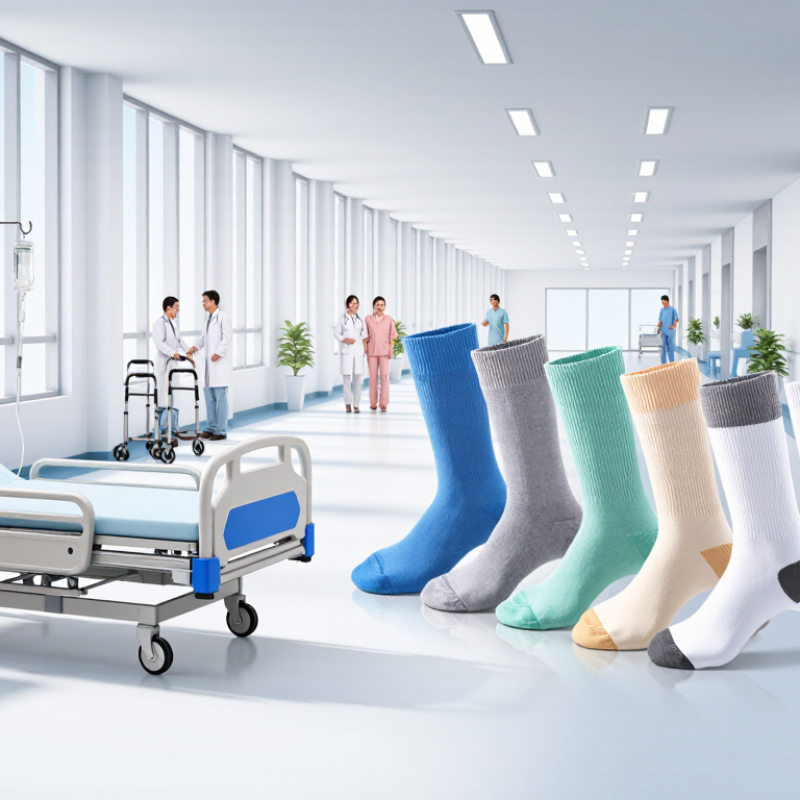
Non-skid hospital socks are designed with rubber, silicone, or textured treads beneath the foot. These patterns increase contact with smooth hospital flooring. They also keep patients’ feet warm while supporting basic mobility.
Hospitals commonly provide them to patients who may feel weak, dizzy, sedated, or unfamiliar with the environment. The need is substantial.
The Agency for Healthcare Research and Quality estimates that 700,000 to 1,000,000 hospitalized patients fall annually in the United States.
The World Health Organization also reports that falls cause about 684,000 fatal injuries worldwide each year. These figures do not prove that socks prevent every fall. They show why small safety measures matter.
Non-skid socks can improve traction when patients walk to bathrooms or stand beside beds. However, they should fit firmly without restricting circulation. Loose fabric can bunch under the heel. That creates another problem.
A 2023 clinical review in the Journal of Patient Safety emphasizes that fall prevention requires multiple interventions, including footwear, lighting, alarms, medication review, and staff assistance. Socks alone are not enough.
Their grip may also decline after repeated washing, especially when treads become smooth. This detail is easy to miss during procurement. Effective hospital socks need visible tread coverage, breathable materials, clear sizing, and routine replacement checks. The evidence is helpful, but not perfect. Procurement teams should test them on actual hospital floors before large-scale adoption.
Evaluating China’s top ten hospital sock manufacturers requires more than comparing catalog photos or export prices. In ward procurement, start with evidence that survives use: fiber composition, elastic recovery, cuff pressure, wash durability, and tested slip resistance.
The AHRQ estimates that 700,000 to 1,000,000 hospitalized patients fall annually in the United States.
Non-skid socks cannot prevent every fall, but their grip pattern deserves testing on wet and dry flooring. Ask for coefficient-of-friction results, test methods, flooring materials, and conditioning details. A vague “anti-slip” claim is not enough. It happens often.
A credible supplier should provide lot traceability, inspection records, colorfastness data, and a corrective-action process. Request samples from different production lots. Wash them repeatedly. Inspect grip loss, odor, loose threads, and size shrinkage. Check documented quality controls, such as ISO 9001, but do not treat certification as clinical proof.
WHO’s 2022 Global Report on Infection Prevention and Control reports healthcare-associated infection prevalence of 7% in high-income countries and 15% in low- and middle-income countries.
Cleanable, skin-compatible materials therefore matter. Confirm washing instructions, packaging hygiene, and material declarations. Ask whether workers can reproduce grip placement after 50 or 100 washes. This is where polished samples become less convincing.
Review capacity, lead times, complaint response, and independent laboratory reports. A lower quote may hide weaker elastic, inconsistent sizing, or unverified testing.
China’s top ten manufacturers of non-skid hospital socks are best evaluated by production evidence, not attractive catalogs. Reliable suppliers usually operate dedicated knitting lines, automated linking machines, and silicone or PVC grip printing equipment. Their products should fit hospital wards, rehabilitation centers, and elder-care facilities.
A strong manufacturer provides documented tests for grip performance, wash durability, colorfastness, and fabric composition. Cotton-rich blends can improve comfort, while polyester and elastane support shape retention.
The sole pattern matters. Small, evenly spaced grips may perform better on smooth floors than large printed blocks. Ask each supplier for samples after repeated washing, not only fresh samples. Check whether the socks remain flexible after drying.
The leading ten Chinese producers should also show batch traceability, stable sizing, and clear inspection records. Factories with in-house quality teams can respond faster when defects appear.
Useful questions include: Are materials tested for restricted substances? Can production follow hospital color and size codes? Is the grip coating latex-free when required? Packaging should protect pairs from dust and moisture.
I would not rank a factory by export volume alone. That measure can hide inconsistent quality. In practice, some smaller producers offer better inspection control, although their delivery capacity may be limited. Buyers should compare production records, sample results, certifications, and communication before approving large hospital orders.
Chinese non-skid hospital sock manufacturers usually supply adult, pediatric, and bariatric sizes. Their common products include ankle socks, crew socks, thermal socks, and disposable options. Most designs use cotton, polyester, bamboo fiber, or blended yarns. Soft terry interiors improve comfort during long bed stays. Silicone or PVC grip dots help reduce slipping on polished floors. Some factories also offer latex-free versions for sensitive users.
Customization can include size grading, cuff height, yarn composition, color, and grip pattern. Buyers may request hospital colors, private labels, woven logos, or printed packaging. Manufacturers can adjust dot density for different floor conditions. However, more grip is not always better. Dense patterns may reduce flexibility or feel uncomfortable. Reliable suppliers should provide pre-production samples, material details, and test records. Ask about wet-floor and dry-floor slip testing, colorfastness, shrinkage, and repeated washing performance. These checks reveal weaknesses that product photos hide.
Tips: Request samples in several sizes. Test them with real footwear and flooring. Confirm packaging language, carton counts, and delivery tolerances before placing a large order. A supplier’s response to defects matters as much as its catalog. Sometimes a smaller order gives better evidence than a confident sales promise.
Choosing the Right Chinese Hospital Sock Supplier
When comparing Chinese hospital sock manufacturers, begin with product function, not catalog size. Non-skid socks should grip smooth floors without feeling harsh against sensitive skin. Ask for samples with different sole patterns, yarn blends, and cuff pressures. Test them on polished tile, hospital vinyl, and slightly damp surfaces. A sample that performs well on cardboard may fail on a real ward floor.
Supplier verification requires more than attractive photographs. Request factory registration details, production capacity, quality procedures, and recent test reports for the intended market. Check whether the factory controls knitting, printing, finishing, and packing internally. Outsourcing is not automatically risky, but unclear subcontracting can weaken consistency. Review measurements after washing, including shrinkage, grip durability, colorfastness, and seam comfort. Keep records with photographs and signed specifications.
Communication also reveals reliability. A capable supplier should explain material choices clearly and answer technical questions without vague promises. Confirm minimum order quantities, lead times, packaging, labeling, and replacement terms before payment. Price matters, but an unusually low quotation may hide thinner yarn or weaker grip dots. I have found that buyers sometimes test only one pair, then regret skipping a larger wash trial. That shortcut is tempting. It is also poor evidence. A small pilot order, followed by independent inspection, can expose problems before hospital-wide purchasing.
Test grip on polished tile, hospital vinyl, and slightly damp floors. Ask for friction results, test methods, and floor materials. One surface is not enough.
The claim may not show real performance. Request documented grip testing and conditioning details. A sample can look excellent yet fail after washing.
Wash samples repeatedly according to the supplier’s instructions. Check grip loss, shrinkage, loose threads, odor, and color fading. Fifty or one hundred washes reveal more.
Request fiber composition, material declarations, and skin-compatibility information. Soft yarn matters for sensitive skin and long ward shifts. Harsh fabric is a warning.
Measure cuff pressure and sock dimensions before and after washing. Check whether the cuff stays secure without leaving deep marks. Comfort can be overlooked.
Ask for lot traceability, inspection records, colorfastness data, and corrective-action procedures. Request samples from different production lots. One perfect pair proves little.
No. A quality certificate shows a management process, not complete clinical effectiveness. Independent laboratory reports and practical ward testing remain necessary. Certification helps, but it is not final evidence.
Confirm capacity, lead time, minimum order quantity, packaging, labeling, and replacement terms. Clarify whether knitting, printing, finishing, and packing are handled internally. Unclear subcontracting may weaken consistency.
Not always. A low price may reflect thinner yarn, weaker grip dots, or inconsistent sizing. Run a small pilot order and use independent inspection. I would not trust price alone.
Non Skid Hospital Socks are designed to provide warmth, comfort, hygiene, and improved traction for patients, helping reduce the risk of slipping on smooth hospital floors. This article explains how these socks are used in hospitals, clinics, rehabilitation centers, and elderly care facilities, while also outlining the key factors for evaluating Chinese manufacturers. Important considerations include material quality, anti-slip performance, cushioning, breathability, size range, production capacity, certifications, quality control, delivery reliability, and communication.
The article also introduces ten types of qualified Chinese manufacturers without focusing on brand names, highlighting the products and customization options they may offer. These can include different sock lengths, colors, grip patterns, fabric blends, packaging styles, hospital logos, labeling, and private-label services. It concludes with practical guidance for selecting a suitable supplier by comparing samples, minimum order quantities, pricing, customization capabilities, inspection procedures, lead times, and after-sales support.

MIFO