The global demand for performance sportswear is reshaping how buyers evaluate Men's Basketball Socks suppliers. Grand View Research valued the global sports apparel market at approximately USD 244 billion in 2023, showing the scale of this category. Its analysis also identifies technical fabrics, comfort, and product innovation as important growth drivers.
Basketball socks are small products with demanding jobs. A player needs stable arch support, breathable mesh, and cushioning under the heel and forefoot. A poor seam can become painful during repeated sprints. Sweat retention can also affect comfort inside the shoe.
This guide examines the Top 10 Men's Basketball Socks Suppliers Worldwide? It considers manufacturing experience, material choices, customization capacity, quality systems, and international fulfillment. These factors matter to retailers, team managers, private-label brands, and professional buyers.
The selection also reflects findings from the International Trade Centre’s trade data resources and industry research from Allied Market Research. Those sources show how sportswear supply chains increasingly depend on material performance, export capability, and consistent production. However, supplier claims still require verification.
A polished website is not enough.
Buyers should request fabric specifications, sample pairs, testing records, and production references. Important details include nylon or polyester ratios, elastane recovery, terry-loop density, and washing performance. Some suppliers may offer excellent pricing but weaker consistency between production batches.
No ranking is flawless. Regional freight costs, minimum order quantities, and certification requirements can change the best choice for each buyer. This overview provides a practical starting point, while careful sampling remains essential before signing a large order.
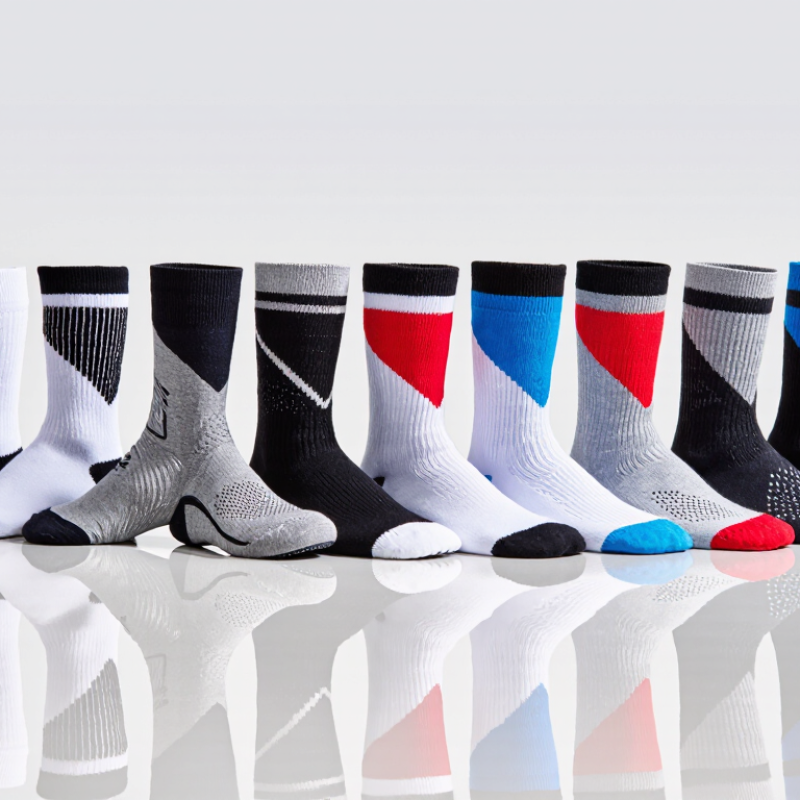
Global demand for basketball socks follows the sport’s expanding participation base. FIBA reported more than 450 million basketball players worldwide in its Global Basketball Report. The figure includes recreational and organized players. It also signals demand beyond professional leagues.
However, public reports rarely separate basketball socks from broader sportswear. That limitation matters. Grand View Research valued the global sports apparel market at over USD 200 billion in recent reporting, with performance materials supporting continued growth. For buyers, the top-ten supplier ranking should therefore measure basketball-specific capability, not only company size. Key indicators include moisture management, arch support, blister prevention, reinforced heels, and stable production capacity.
A practical global ranking places suppliers with tested technical fabrics and consistent factory audits near the top. The next tier includes specialists offering custom knitting, low minimum orders, and rapid sampling. Other strong candidates provide recycled yarn options, automated quality checks, and regional warehouses. The final positions should reflect dependable delivery, transparent testing, and competitive pricing. These criteria are more useful than advertising claims.
Demand is visible on the court. Players need dense cushioning under the forefoot, while coaches often prefer compression around the ankle. Retailers also request brighter designs and mixed-size packs. The weakness is data quality. Supplier rankings can change quickly when freight costs, certification records, or defect rates shift. Buyers should verify recent samples, wash performance, and factory documentation before accepting any ranking as permanent.
For a global men’s basketball sock supplier, technical proof matters more than attractive product photography. ASTM D4966 uses the Martindale method to measure textile abrasion resistance through controlled rubbing cycles. The standard provides a testing procedure, not a universal pass-or-fail limit. Buyers must define performance targets for each sock construction.
In supplier evaluations, I would request test reports showing pressure, abrasive material, cycle count, specimen condition, and failure point. A sock that survives 30,000 cycles may still develop pilling after washing. That gap deserves attention. Testing should include the heel, toe, and forefoot, where repeated court friction is concentrated. Results become more useful when paired with laundering and stretch-recovery checks.
Fiber ratios also influence comfort and durability. Textile Exchange’s Materials Market Report 2024 reported polyester at about 59% of global fiber production in 2023, while polyamide represented roughly 5%. A practical basketball blend may contain 55–70% polyester, 20–35% polyamide, and 3–8% elastane. These ranges are not a formula. Polyamide can improve abrasion resistance, while elastane supports compression and shape retention. Too much elastane may reduce moisture transport and raise heat near the ankle. Too little can create loose fabric after washing. Supplier data should disclose fiber percentages, yarn structure, test laboratories, and sampling dates. Independent verification remains valuable, because one impressive report cannot represent every production batch.
Technical benchmark snapshot: ASTM D4966 abrasion performance and fiber-blend ratios
The chart uses anonymized supplier benchmark profiles rather than company or brand names. Fiber percentages represent typical commercial construction targets and total 100%. Abrasion values show representative ASTM D4966 Martindale test cycles; actual results vary with yarn, knitting density, pressure, abradant, and test endpoint.
Comparing basketball sock suppliers requires more than checking unit price. Request MOQ, monthly capacity, lead time, and certification records in one spreadsheet. Typical MOQs range from 500 to 5,000 pairs for standard designs. Custom knitting, packaging, and team colors can raise minimums quickly. Production capacity varies widely, from 20,000 to over 500,000 pairs monthly. Treat these figures as claims until factory records support them.
Lead times commonly run 25–45 days after sample approval. Peak-season orders may take longer. Ask whether yarn booking, knitting, embroidery, inspection, and shipping are included. Textile Exchange’s Materials Market Report 2024 states that polyester represented about 59% of global fiber production in 2023. This matters because recycled polyester claims require traceable documentation, not only a printed hangtag. Useful certifications include ISO 9001, OEKO-TEX STANDARD 100, Global Recycled Standard, and social-compliance audit evidence. Certification scope must match the actual production site.
Tips: Ask for a live factory video, recent audit date, and three shipment references. Test cushioning, arch support, wash durability, and colorfastness before selecting a supplier. A 2024 sporting-goods market analysis by McKinsey reported continued mid-single-digit industry growth, increasing pressure on delivery reliability. Still, capacity numbers can be optimistic. One supplier quoted 60,000 pairs monthly, but delivered only 18,000 during a holiday period. That gap deserves careful questioning. Insist on a written production schedule, inspection checkpoint, and remedy for late delivery.
A serious supplier comparison starts with measurable comfort, not catalog language. The 2024 Textile Exchange Materials Market Report states that polyester represented about 59% of global fiber production in 2023. That matters because synthetic yarns can dry quickly, but fiber choice alone proves little. Ask suppliers for AATCC TM195 moisture-management results, including drying time, spreading speed, and one-way transport. Check the test fabric, wash count, and laboratory conditions. Numbers without those details are weak evidence.
Cushioning needs a similar test. Suppliers should disclose heel and forefoot thickness, material density, and compression recovery after repeated washing. A practical evaluation can use force-plate testing and compare pressure under the heel during jumping drills. Compression should be recorded in mmHg, not described as “tight support.” ISO 20932-1 offers a useful framework for measuring elastic textile properties. However, sock compression is not identical to medical compression. Fit remains personal.
A 2023 review in Sports Medicine reported that compression garments may support recovery, while performance benefits remain inconsistent. That finding should temper exaggerated claims. Measure calf circumference, ankle fit, arch tension, and toe-box length across several sizes. A good pair stays flat inside the shoe. It should not leave deep marks after a full practice. I would also request independent wash-testing data. Some fabrics feel excellent on day one, then lose shape quickly. That weakness deserves attention.
Choosing among the top ten suppliers requires more than comparing catalog prices. Unit cost should include knitting, packaging, sampling, shipping, and possible inspection fees. A quote of $1.20 may become $1.55 after these additions. Ask for a detailed cost sheet. Also check minimum order quantities, payment terms, and replacement policies. My first costing model missed packaging changes. That mistake reduced the expected margin.
Customization should support performance, not only appearance. Request fabric percentages, cushioning maps, arch support, ankle compression, and logo placement limits. A practical sample should survive repeated washing and court movement. Check colorfastness under sweat and detergent exposure. Suppliers should explain their testing methods clearly. Small details matter.
Compliance protects both buyers and athletes. Request current material declarations, factory audit records, and test reports from recognized laboratories. Verify that labels match the actual fiber content. Do not accept copied certificates without checking dates and issuing organizations. Delivery performance needs equal attention. Review production lead times, sample approval stages, shipping routes, customs documents, and historical on-time rates. A supplier promising seven days may overlook peak-season delays. Use a written timeline with inspection dates and a backup freight option. Some vendors provide excellent samples but struggle with repeat orders. That gap deserves careful review.
Request drying time, spreading speed, and one-way moisture transport results. Ask about fabric type, wash count, and laboratory conditions. Numbers alone are weak evidence.
Check heel and forefoot thickness, material density, and recovery after repeated washing. Force-plate testing can compare heel pressure during jumping drills. Test after washing.
Ask for compression values in mmHg, not vague claims like “tight support.” Measure calf circumference, ankle fit, and arch tension. Fit remains personal.
The sock should stay flat inside the shoe and avoid deep marks. Check toe-box length across several sizes. A small wrinkle can become irritating quickly.
Include knitting, packaging, sampling, shipping, inspection, and possible replacement fees. Also review minimum order quantities and payment terms. A $1.20 quote may become $1.55.
Request fabric percentages, cushioning maps, arch support, ankle compression, and logo placement limits. Test colorfastness against sweat and detergent. Appearance is not enough.
Request current material declarations, factory audit records, and laboratory test reports. Confirm labels match actual fiber content. Check certificate dates and issuing organizations.
Examine production lead times, sample approvals, shipping routes, customs documents, and past on-time rates. Use written inspection dates and backup freight options. Seven days may be optimistic.
Some suppliers provide excellent samples but struggle with later orders. Compare production quality across several batches. I once overlooked packaging changes, and the margin suffered.
This guide examines the global market for Men's Basketball Socks and presents a practical framework for comparing leading suppliers worldwide. It considers demand trends, supplier scale, production capacity, minimum order quantities, lead times, certifications, and international delivery performance. Buyers can use these factors to identify reliable manufacturing partners for team orders, retail programs, and customized collections.
The article also explains key technical benchmarks, including ASTM D4966 abrasion testing and the importance of balanced fiber-blend ratios for durability, stretch, and comfort. Product evaluation focuses on cushioning, targeted compression, moisture-wicking performance, ventilation, arch support, and fit stability during intensive play. Finally, the guide outlines essential purchasing criteria such as unit cost, customization options, quality control, compliance documentation, packaging, and communication efficiency, helping buyers make informed decisions while maintaining consistent product performance and supply reliability.

MIFO