What Are the Best Hospital Non Slip Socks from China?

Time:2026-09-30 Author:Mason
0%

Hospital Non Slip Socks help patients move more confidently between beds, bathrooms, and treatment areas. In a hospital, a damp floor or loose-fitting sock can turn a short walk into a real concern. Small details matter. Grip pattern, fabric feel, cuff pressure, and sizing all affect daily comfort and use. Buyers comparing products from China should look beyond colorful designs and low quoted prices. They need clear specifications and reliable sample checks.

There is no single best pair for every facility. A warm, breathable blend may suit one ward, while a softer, easy-to-launder option may work better elsewhere. Grip should be checked on the actual floor types where socks will be worn, not judged from a product photo alone. Ask suppliers about material composition, size ranges, washing guidance, packaging, and quality inspection. Request samples. Test them. A clear answer from a supplier is useful, but it is not proof of consistent production. That still needs verification.

This guide explores practical ways to compare Chinese manufacturers and product options. It considers grip, comfort, durability, customization, and communication. Some recommendations may depend on a facility’s own trial results. That is worth admitting. A sock can look suitable on paper and feel wrong after several hours of wear. The goal is to make a careful, evidence-informed choice for patients and purchasing teams.
What Are the Best Hospital Non Slip Socks from China?

What Hospital Non-Slip Socks Are and How They Work

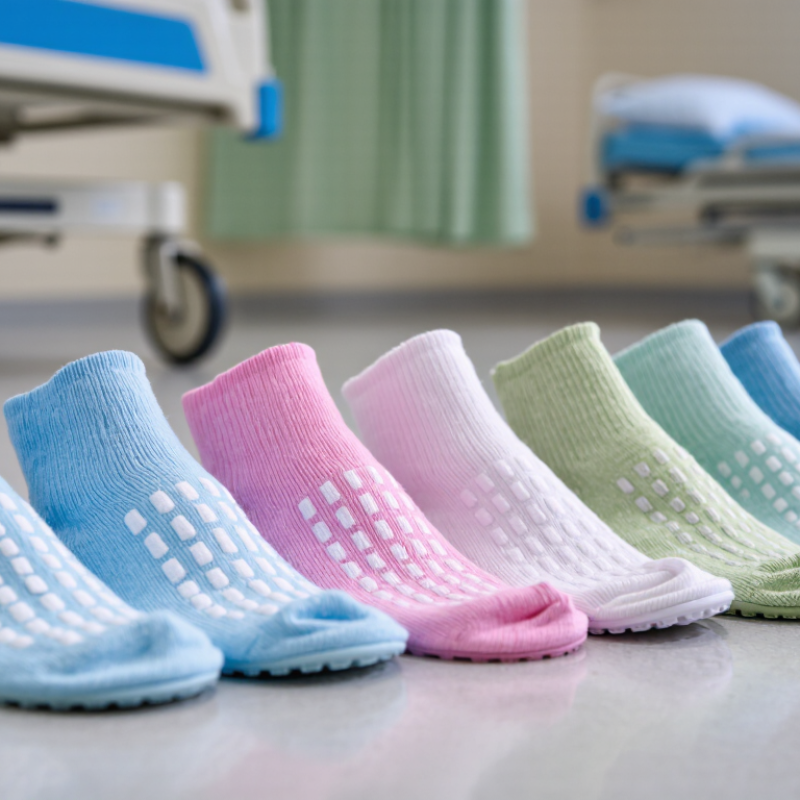
Hospital non-slip socks are knitted socks with gripping areas beneath the sole. These areas usually use silicone, rubber, or textured polymer dots. They create friction between the foot and smooth hospital floors. That friction helps reduce sliding during short walks, transfers, and bedside movement.

The sock must fit closely without squeezing the ankle. A loose heel can fold inside a shoe or twist during walking. Good designs also use breathable yarn, reinforced toes, and gentle cuffs. Moisture matters. Damp fabric may feel less secure, even when the grip pattern looks strong. The grip should cover the forefoot and heel, not only the middle sole.

A practical hospital check includes walking, turning, and standing from a chair. Staff should inspect the dots after repeated washing. They may wear down sooner than expected. This is an important weakness. Non-slip socks support safer movement, but they cannot replace supervision, mobility aids, or suitable footwear.

Chinese manufacturers commonly produce these socks through automated knitting, grip application, and batch inspection. Buyers should request material details, size measurements, wash-cycle results, and test records. There is no single design for every patient. Older adults, children, and patients with swelling need different fits. A cheaper pair may look acceptable but lose elasticity quickly. Careful sampling reveals that problem before hospital-wide purchasing.

Key Safety, Comfort, and Hygiene Features

What Are the Best Hospital Non Slip Socks from China?

The best hospital non slip socks from China should protect patients during short walks and sudden transfers. A reliable pair uses dense, evenly spaced grips across the sole. These grips should remain flexible, not feel like hard plastic under the heel.

Grip matters. Check traction on polished floors, bathroom tiles, and dry bedside surfaces. A qualified buyer should request abrasion and slip-resistance test data, not rely only on product photographs. The cuff also needs gentle compression. It should stay up without leaving deep marks on fragile skin.

Comfort supports safer movement. Soft cotton blends can reduce irritation, while breathable knitting helps manage sweat during long hospital stays. The toe seam should be flat or carefully covered. Bulky stitching can create pressure points inside loose footwear.

Fit matters too. Socks that slide inside slippers may increase tripping risk, even with strong sole grips. Different sizes are essential for children, adults, and patients with swollen feet. Materials should tolerate repeated washing, drying, and disinfecting procedures recommended by the care facility.

Hygiene requires more than a clean appearance. Look for colorfast fabric, odor control, and construction that dries within a practical timeframe. Suppliers should explain fiber content, washing limits, packaging protection, and quality inspection methods.

Batch consistency matters when hospitals reorder large quantities. Small details count. I would still test samples with nurses and patients before purchasing. A sock may pass a factory check yet feel uncomfortable after eight hours. That gap deserves honest review.

Materials and Construction Used in Chinese Hospital Socks

What Are the Best Hospital Non Slip Socks from China?

Materials and Construction Used in Chinese Hospital Socks

Chinese hospital socks commonly combine cotton, polyester, nylon, and a small amount of elastane. Cotton improves softness and moisture absorption. Polyester adds drying speed and shape retention. Nylon strengthens high-wear areas, especially around the heel and toe. Elastane helps the cuff stay secure without excessive pressure.

Construction matters as much as fiber choice. Many socks use circular knitting, which creates a flexible tube with fewer irritating seams. A terry-loop interior can cushion the sole and reduce friction during walking. Some factories add a seamless toe closure. This detail feels minor, but it can prevent rubbing against sensitive skin.

The grip pattern needs careful inspection. PVC or silicone dots are often placed under the forefoot and heel. A balanced pattern supports traction without making the sock rigid. Too few dots may slide on polished floors. Too many can feel uncomfortable in bed. Details matter.

In quality checks, I would examine dot adhesion after repeated washing, cuff recovery, and loose threads. A sock may feel excellent when new, yet lose grip after several cycles. That weakness is easy to overlook. Some low-cost constructions also use dense synthetic yarns that trap heat. This is not always a defect, but it deserves testing for different patients and seasons. A practical choice should consider softness, breathability, wash durability, and secure floor contact together.

How to Assess Quality, Fit, and Safety Standards

What Are the Best Hospital Non Slip Socks from China?

Choosing hospital non slip socks requires more than checking a rubber pattern. The CDC reports that one in four adults aged 65 and older falls each year. AHRQ also places inpatient fall rates near 3–5 per 1,000 patient-days. These figures make grip, fit, and traceable testing essential.

Ask Chinese suppliers for independent laboratory reports, material percentages, and batch inspection records. The sole should maintain traction on smooth, wet, and lightly disinfected floors. ISO 13287 offers a useful footwear test method, but it is not written specifically for socks. Responsible suppliers should explain any adapted procedure clearly. I would not trust color alone. Silicone dots may look strong but peel after repeated washing. Request wash-cycle evidence, especially after 20–30 industrial washes.

Fit affects safety as much as friction. Check calf stretch, heel placement, toe-room, and compression around swollen ankles. A loose heel can bunch under the foot. A tight cuff can leave marks on fragile skin. Look for flat seams, secure elastic, breathable yarn, and latex disclosure. Suppliers should provide size measurements, not vague labels such as “large.” Packaging should identify fiber content, washing limits, production batches, and applicable chemical-safety requirements. One detail is easy to miss: socks must stay on during transfers, not only while standing. My assessment can still be imperfect, so pilot testing with nurses and several patient body types is wiser than trusting a sample pair.

What Are the Best Hospital Non Slip Socks from China? - How to Assess Quality, Fit, and Safety Standards

Assessment area What to check Useful evidence or method Why it matters
Grip pattern and coverage Check that grip elements cover the intended weight-bearing areas, such as the heel and forefoot, and are evenly attached without bare patches or peeling edges. Inspect samples before and after laundering; ask for documented checks of grip adhesion and durability. Coverage and attachment can affect contact with the floor. A visual check alone does not establish slip resistance.
Slip-resistance evidence Ask what test method was used, the test surface, contaminant or wet/dry condition, sample preparation, and the reported result. Request a current report from a competent, preferably accredited, independent laboratory and confirm that the tested item matches the supplied sock. Slip performance depends on test conditions. Results for footwear should not automatically be treated as certification of socks.
Standards and claims Check the exact standard and scope behind any “tested,” “compliant,” or “certified” claim. ISO 13287 is a test method for slip resistance of personal protective equipment footwear. ASTM F2913 is a test method for evaluating footwear slip performance. Verify applicability to the actual product and test configuration. These references concern footwear; they do not, by themselves, certify a hospital sock. Ask for evidence specific to the sock and its intended use.
Fit and size range Compare the wearer’s measured foot length with the product’s size chart. Check for heel alignment, a secure but non-restrictive fit, and no toe crowding or excess fabric underfoot. Request size charts in centimetres and assess fit on representative users. Do not rely on S/M/L labels alone, as sizing conventions vary. Poor fit can cause bunching or movement inside the sock, which may compromise comfort and stability.
Elasticity and circulation comfort Check that cuffs stay in place without digging into the leg; review stretch and recovery after repeated wear and washing. Conduct wearer trials and inspect for persistent cuff marks, slipping, or loss of shape. Follow clinical guidance for people with circulation concerns. A comfortable fit is important for extended wear. Non-slip socks are not a substitute for individually prescribed compression garments.
Materials and labeling Review the stated fibre composition, care instructions, size, and any relevant warnings. Check that product and packaging information agree. Request material specifications and applicable chemical-safety documentation for the destination market; verify claims against the finished product. Labelling and chemical requirements vary by market. A material declaration is not, on its own, proof of safety or performance.
Laundering durability Check whether grip elements crack, peel, become hard, or lose coverage after washing and drying according to the care label. Review documented wash-cycle conditions and inspect tested samples. Confirm that care instructions reflect the intended cleaning process. Grip condition may change with laundering. Do not assume a new-sample result applies after repeated washing.
Construction and quality control Look for consistent stitching, smooth seams, correct size marking, secure grip application, and no holes, loose threads, or sharp edges. Set written acceptance criteria for sample inspection and request batch inspection records or a defined defect-check process. Consistent construction supports comfort and helps reduce avoidable product defects.
Intended use and wearer needs Confirm the sock is appropriate for the intended floor conditions, footwear policy, wearer mobility, and clinical setting. Review local fall-prevention procedures and obtain input from clinical or procurement staff before selection. Non-slip socks do not eliminate fall risk. Follow facility guidance and use suitable mobility assistance when needed.

Note: Use this table as a purchasing assessment guide, not as a certification or guarantee of clinical performance. Confirm requirements with the relevant facility and destination-market regulations.

How to Choose a Hospital Sock Manufacturer in China

What Are the Best Hospital Non Slip Socks from China?

How to Choose a Hospital Sock Manufacturer in China

Choosing a hospital sock manufacturer in China requires more than comparing prices. AHRQ estimates that 700,000 to 1 million hospitalized patients fall annually in the United States. This makes grip performance, fit, and laundering durability important purchasing criteria. Ask manufacturers for friction test results on dry and wet flooring, not only product photos. ASTM D1894 can support comparative friction testing, while ISO 12947 helps assess abrasion resistance.

Look for factories with documented quality systems, traceable yarn sources, and controlled production records. Request samples from different production batches. Check the silicone or PVC grip pattern after repeated washing, stretching, and drying. The World Health Organization reported that healthcare-associated infections affect about 7% of acute-care patients in high-income countries and 15% in low- and middle-income countries. Socks do not prevent infection, but washable materials, color controls, and clear care instructions support safer use.

Ask for an independent factory audit, current ISO 9001 documentation, and test reports from accredited laboratories. Confirm lead times, minimum order quantities, packaging controls, and complaint handling before signing a contract. A reliable supplier should explain fiber content, size tolerance, dye safety, and shrinkage results in plain language. Samples can mislead. I once underestimated how quickly grip prints wear under hospital-style laundering. That mistake showed why performance testing must match real care conditions, not showroom conditions.

How to choose: Compare manufacturers using a consistent scorecard. The percentages below are suggested evaluation weights—not survey results or claims about specific suppliers. Verify certifications, test reports, sample performance, production capacity, and quoted terms before making a decision.

FAQS

What features should hospital non-slip socks have?

Look for flexible grips spaced across the sole, breathable fabric, flat toe seams, and a cuff that stays up without marking skin.

How can buyers check whether the grips work?

Request independent traction results for smooth, wet, and lightly disinfected floors. Product photos are not enough.

What should buyers know about grip durability?

Ask for wash-cycle evidence and inspect samples after repeated laundering. Grip dots can peel or wear down.

How important is the fit?

Very important. A loose heel can bunch under the foot, while a tight cuff may leave marks. Check sizing for swollen feet, too.

Which comfort details matter during long stays?

Soft, breathable yarn can reduce irritation and manage sweat. Bulky toe stitching may create pressure inside loose footwear.

What supplier records should be requested?

Ask for fiber details, batch inspection records, size measurements, washing limits, and reports from independent laboratories.

Can footwear testing methods assess socks?

Some methods can support comparisons, but they may not be designed specifically for socks. Ask suppliers to explain their procedures.

How should hospitals assess a supplier’s samples?

Test pairs with nurses and patients during transfers and routine care. One sample may feel fine briefly, then become uncomfortable after hours.

What should buyers check beyond grip and comfort?

Review dye colorfastness, drying time, packaging, shrinkage, and instructions for repeated washing. Small details matter.

Conclusion

Hospital Non Slip Socks help reduce the risk of slips and falls in clinical settings by using grip patterns on the soles to improve traction on smooth floors. The best options combine dependable slip resistance with a comfortable fit, breathable materials, and construction suited to frequent wear and washing. Features such as secure cuffs, smooth seams, and moisture-managing fabrics can support comfort and hygiene during use.

When assessing socks made in China, consider the materials, stitching, grip durability, size range, and consistency between samples and production batches. Check that sizing is clear and that the socks stay securely in place without feeling restrictive. Choosing a manufacturer also involves reviewing quality-control processes, communication, production capacity, and the ability to meet your specifications. These factors help buyers select hospital socks that balance safety, comfort, and dependable quality.


Mason

Mason

Mason is a seasoned marketing professional with a deep expertise in the company's offerings and a passion for driving brand awareness. With a strong background in digital marketing strategies, he has an innate ability to connect with diverse audiences and effectively communicate product benefits.......